

Essential Equipment and Processes for Sheet Metal Fabrication
In the manufacturing industry, sheet metal fabrication serves as a core technology for shaping metal sheets and is widely applied in automotive manufacturing, electronics, architectural decoration, and other fields. From precision electronic enclosures to industrial equipment housings, sheet metal components have become indispensable in modern industry due to their high precision, lightweight design, and structural stability. So, what equipment and processes are typically required for sheet metal fabrication? Below, we provide a detailed introduction.
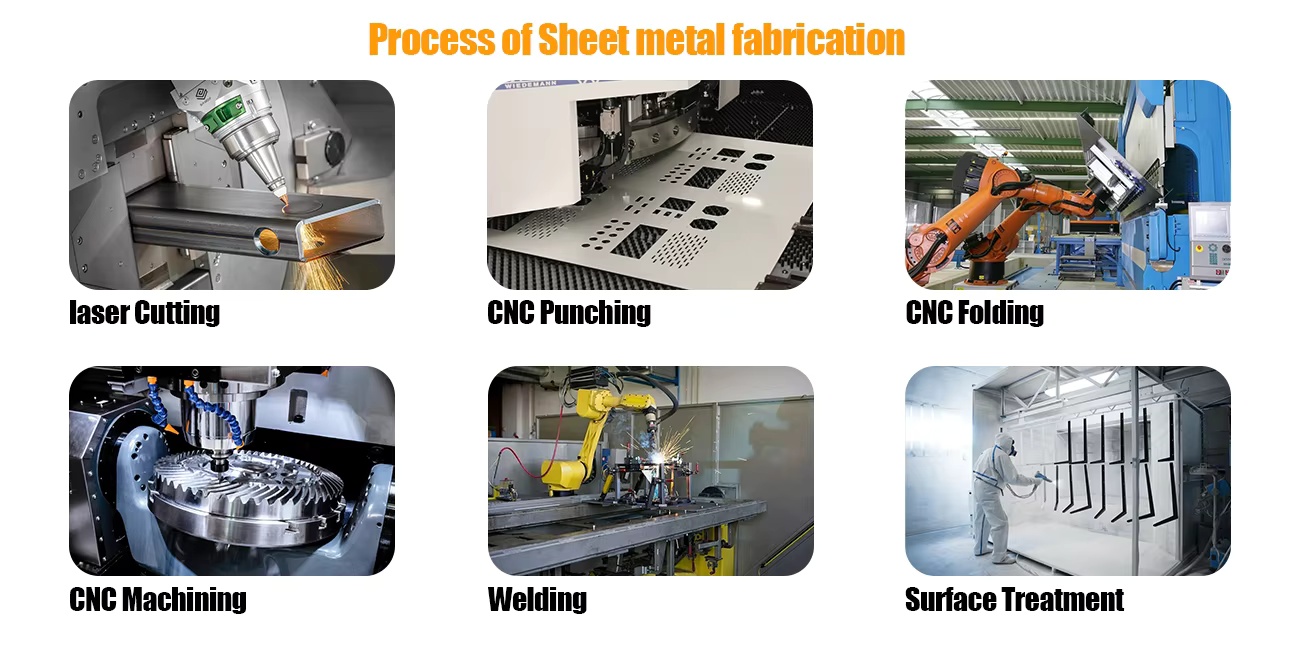
1. Core equipment: 1. Cutting equipment Shearing machine: suitable for cutting simple parts with regular shapes, fast speed, and low cost, but limited accuracy. Laser cutting machine: complex shape cutting is achieved through a high-energy laser, with an accuracy of up to ±0.1mm, supporting materials such as stainless steel and aluminum plates, suitable for small batches or high-precision requirements. CNC Punching Machine: Equipped with a turret-type mold library, it can complete punching, stretching holes, rib pressing, and other operations at one time, with high processing efficiency, suitable for medium-thickness plates (such as cold-rolled plates ≤3.0mm, aluminum plates ≤4.0mm). 2. Forming equipment Bending machine: Plate bending is achieved through V-shaped molds, with an accuracy of ±0.1mm (single fold). Key parameters include bending radius (to avoid material cracking), bending sequence (first inside and then outside, first small and then large), and process hole design (to prevent size mutation). Punching machine: Blanking, punching, stretching,g, and other operations are achieved through molds, suitable for mass production, but the mold cost is relatively high.
3. Connection equipment Spot welding machine: used for plate splicing, the welding gap needs to be controlled at 0.5-0.8mm, and the spacing between welding points is adjusted according to the force requirements (non-stressed parts can be relaxed to 70-80mm). Argon arc welding machine: suitable for high-strength connections, uniform and smooth welds, but low efficiency. 4. Auxiliary equipment Unwinder: Automatically unwind the coil and improve continuous production efficiency. Leveling machine: Eliminate plate stress and ensure processing accuracy. Deburring machine: Process cutting-edge burrs and improve surface quality. 2. Process flow: 1. Material preparation Select plates (such as cold-rolled steel plates, stainless steel, aluminum plates) according to design requirements and check the surface quality (no serious scratches or rust spots). 2. Cutting Laser cutting: Suitable for proofing or small batch production, with high cost but strong flexibility. CNC punching machine: Suitable for medium batch production, efficient processing through mold combination. Mold cutting: Suitable for large-scale production, high initial mold cost but a low unit cost. 3. Forming Bending: Determine the bending sequence and tool parameters based on the unfolded diagram to avoid collision between the product and the tool. Stretching: Complex shape forming is achieved through stretching molds, and the stretching coefficient (generally 3-5 times the plate thickness) and fillet radius (≥ plate thickness) need to be controlled. 4. Connection Spot welding: suitable for thin plate splicing, the welding surface must be flat. Riveting: The auxiliary parts are fixed by rivet nuts and rivet studs, which are suitable for scenes that need to be disassembled. 5. Surface treatment Powder spraying: improves corrosion resistance and aesthetics, suitable for outdoor equipment. Wire drawing: forms regular textures, hides minor scratches, and improves touch. Electroplating: achieves high corrosion resistance or conductivity requirements, such as electronic equipment housing.
Conclusion
For manufacturers, mastering core equipment and processes is key to enhancing competitiveness. For customers, understanding the full chain of sheet metal fabrication helps in making informed product decisions.
This overview covers the essential equipment and processes in sheet metal fabrication, ensuring high-quality production across various industries.